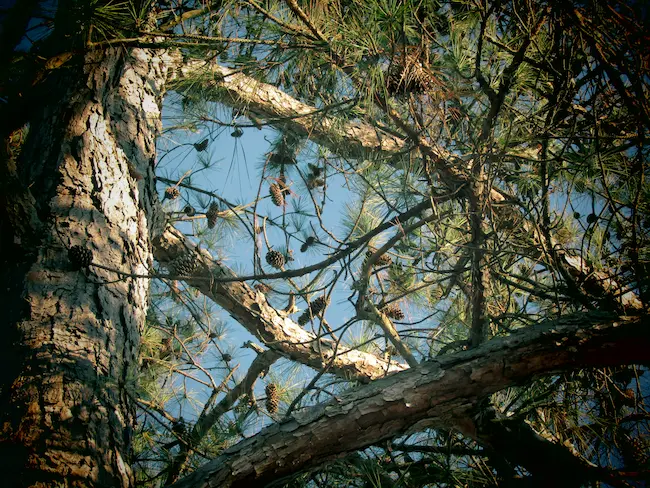

The longevity of trees is a biological strategy rather than a fixed number, with natural lifespan differences between species driven by physiological and ecological factors. Long-lived trees, such as the ancient Thuja occidentalis on the cliffs of the Niagara Escarpment, exhibit constrained growth and cambial mortality, allocating resources to defensive compounds rather than rapid reproduction[1]. This slow survival strategy allows them to endure harsh environmental conditions and resist pathogens over centuries. The xylem and mycorrhizae of these trees are adapted for long-term stability, enabling them to store carbon and maintain structural integrity over extended periods[4]. Unlike fast-growing species, long-lived trees prioritize longevity through gradual resource accumulation and minimal senescence, showcasing that age does not equate to weakness.
The biological time scales of long-lived trees, spanning decades to millennia, highlight their unique adaptations to slow growth and prolonged survival. Research indicates that some trees possess the potential for near-immortality, with genetic backgrounds influencing their longevity[2][5]. These trees exhibit robust mechanisms for resisting environmental stressors and maintaining cellular health, allowing them to thrive in diverse ecosystems. The study of these long-lived species provides insights into the complex interplay between genetic, physiological, and ecological factors that contribute to their extended lifespans, emphasizing the importance of understanding time scales in ecological and evolutionary contexts[3].