This Week in Tree Conservation Science
Welcome to this week's Tree Conservation digest, where we delve into the intricate science behind tree survival and longevity. This edition spotlights groundbreaking research that unravels the complex mechanisms trees employ to endure and thrive under various environmental pressures. From the hydraulic strategies that prevent catastrophic failure during droughts to the subterranean "chemical warfare" that shapes forest ecosystems, recent studies provide profound insights into the biological processes that sustain our arboreal giants. This week, we examine how conservation practices influence soil health and carbon storage, the survival tactics trees use to combat hydraulic failure and carbon starvation, and the remarkable resilience and vulnerability of ancient tree species in the face of climate change.
Notable research from Michigan State University reveals the long-term impacts of conservation practices on soil health and carbon content over a 25-year period, highlighting the critical role of sustainable land management. Columbia University's allometry-based model offers a novel understanding of how trees balance water transport and carbon assimilation to survive extreme conditions. Additionally, the University of Chicago Press presents a study on the dendrochronology of ancient Thuja occidentalis, shedding light on the growth constraints and cambial mortality that contribute to their extraordinary lifespans. These findings not only enhance our knowledge of tree biology but also inform conservation strategies aimed at preserving forest ecosystems for future generations.
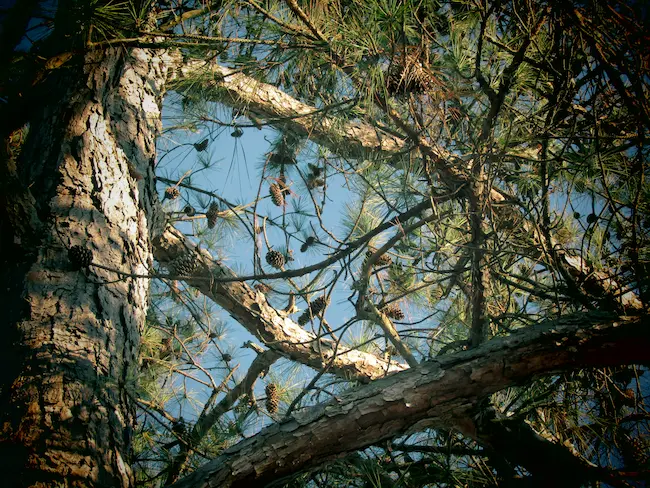
An ancient bristlecone pine in California's White Mountains, one of Earth's oldest living
organisms at over 4,800 years. Understanding what allows trees like this to survive for
millennia is central to modern conservation science.
Why Tree Survival and Longevity Matter
Tree survival is not about sentiment. It is about understanding biological time. A tree that
lives 500 years operates on fundamentally different principles than one that lives 50.
Longevity is an evolutionary strategy built on slow growth, efficient resource use, and
extraordinary stress tolerance. These mechanisms—hydraulic architecture, mycorrhizal networks,
carbon allocation patterns—determine whether a tree survives drought, disease, or disturbance.
Conservation fails when it ignores this biology. Protecting a 300-year-old oak requires
understanding what kept it alive through centuries of variable climate, not just preventing
someone from cutting it down.
A tree's survival depends on decades of accumulated resilience—built through
root architecture, symbiotic relationships, and structural balance. Damage today may not kill
the tree for 10 or 20 years.
The science of tree survival reveals why conservation is complex. Trees don't die from single
events—they die from cumulative stress. Soil compaction, repeated pruning, construction damage,
irregular watering: these accumulate silently. By the time decline becomes visible, the damage
was done years earlier. This is why monitoring root health, mycorrhizal associations, and
hydraulic function matters more than counting leaves. It's why protecting soil matters as much
as protecting the trunk. And it's why understanding species-specific tolerances—how a coast
redwood differs from a desert ironwood—is essential for making conservation decisions that work
over biological time, not political cycles.
The Biological Foundation of Conservation
Every tree conservation decision should start with a question: what does this species need to
survive for the next 100 years? Not what makes it look healthy today. Trees can appear fine
while slowly dying from root damage, fungal disruption, or water stress. The science of longevity
teaches us to think in terms of stress budgets, recovery capacity, and invisible thresholds.
It shows why isolated trees struggle (no mycorrhizal network), why drought memory persists
(xylem damage compounds), and why mature trees are irreplaceable (centuries of established
symbioses).
Conservation that ignores tree biology fails slowly. Understanding survival mechanisms
is what separates informed protection from well-meaning guesswork.
This weekly digest tracks the research that explains these mechanisms: peer-reviewed studies on
stress tolerance, hydraulic failure, mycorrhizal signaling, and resilience. The goal is not to
inspire action but to build understanding. Because conservation grounded in science lasts longer
than conservation driven by urgency. Trees operate on their own timescale. Our job is to understand it.
How Long Trees Are Meant to Live
Age as a biological strategy, not a number
The longevity of trees varies significantly between species, reflecting diverse biological strategies rather than a uniform lifespan[1]. These strategies are deeply rooted in the physiological and ecological adaptations of each species. For instance, long-lived trees such as the Thuja occidentalis exhibit constrained growth and cambial mortality, which are key mechanisms for their extended survival[1]. Unlike fast-growing species, these trees allocate resources towards defensive compounds and structural integrity, rather than rapid biomass accumulation. This approach is evident in their xylem structure, which is optimized for longevity and resilience against environmental stressors[2]. Additionally, the association with mycorrhizal fungi plays a crucial role in nutrient uptake and overall health, further contributing to their longevity[5].
The concept of age in trees should not be conflated with weakness or senescence. In fact, many long-lived species demonstrate remarkable resilience and adaptability[3]. Their slow growth rates are a testament to their evolutionary strategy, prioritizing survival over rapid expansion. This is particularly evident in their carbon storage capabilities, where older trees often exhibit higher carbon sequestration rates due to their extensive root systems and stable xylem structures[4]. The biological time scales involved in these processes—spanning decades to centuries—underscore the complexity and depth of tree longevity as a biological phenomenon, rather than a mere numerical age[1].
Species-Specific Tolerance to Stress
Why some trees endure while others fail
Species-specific tolerance to stress in trees is a complex interplay of physiological and ecological mechanisms. Drought tolerance, for instance, is largely determined by the efficiency of water transport through the xylem and the presence of mycorrhizal associations that enhance water uptake[1]. Salinity tolerance is influenced by the tree's ability to compartmentalize sodium ions within vacuoles or excrete them through specialized glands[3]. Heat and cold thresholds are governed by the stability of cellular membranes and the production of heat shock proteins that protect against thermal stress[4]. Adaptability versus specialization plays a crucial role; generalist species may possess broader stress tolerance due to a wider range of physiological responses, whereas specialists may excel in particular stress conditions but fail under different stressors[5].
The physiological limits of trees under stress are also shaped by their stress response mechanisms. For example, some trees undergo senescence more rapidly under stress, redirecting resources to survival rather than growth[1]. Others may enter a state of dormancy, conserving energy until conditions improve[3]. These responses are not immediate but develop over decades or centuries, reflecting the long-term evolutionary strategies of each species[4]. Understanding these mechanisms is crucial for predicting how different tree species will fare under changing environmental conditions, providing insights into forest resilience and the potential for adaptation over time[5].
The Hidden Role of Soil in Tree Survival
Roots, structure, and long-term stability
The survival of trees is intricately linked to the health and composition of the soil in which they are rooted. Soil compaction, a common issue in disturbed environments, reduces pore space and limits the depth and spread of roots, thereby constraining the tree's access to water and nutrients[1]. Nutrient cycling, facilitated by the soil microbiome, plays a critical role in tree longevity. Microorganisms such as mycorrhizae form symbiotic relationships with tree roots, enhancing nutrient uptake and providing protection against pathogens[2]. The rhizosphere, a dynamic zone surrounding the roots, is a hotspot for microbial activity that influences tree health and resilience over decades and centuries[3]. The disruption of these soil processes not only affects immediate growth but also leads to senescence and reduced lifespan, often more significantly than episodic events like storms[4].
The long-term stability of trees is further influenced by the complex interactions within the soil ecosystem. The arbuscular mycorrhizal fungi (AMF) and other soil microbes contribute to the structural integrity of the soil, promoting root development and stability[5]. These microbes engage in chemical warfare beneath the soil, shaping the forest composition and influencing tree species distribution[1]. The conservation of soil health through practices that maintain microbial diversity and function is essential for the sustained survival of trees. Over time, the cumulative effects of soil health on tree physiology, including xylem function and overall vigor, determine the tree's ability to withstand environmental stresses and ensure its longevity[2].
Water Availability and the Slow Economics of Trees
Timing, access, and balance
The availability of water and the slow economics of trees are intricately linked through physiological mechanisms and ecological dynamics. Seasonal water needs vary significantly, with trees relying on either groundwater or surface water depending on the ecosystem[1]. During periods of drought, trees exhibit a "drought memory," adjusting their physiological processes to cope with water scarcity[2]. Irregular watering can be more detrimental than consistent scarcity, as it disrupts the delicate balance of xylem function and hydraulic efficiency[3]. The xylem, responsible for water transport, can suffer hydraulic failure under irregular water supply, leading to compromised tree health[4]. This failure occurs when the tension in the xylem exceeds its capacity, causing cavitation and impeding water flow[5].
The long-term survival of trees is contingent upon their ability to maintain hydraulic integrity over decades and centuries. Mycorrhizal associations enhance water uptake, while senescence processes allow trees to reallocate resources during stressful periods[1]. The balance between carbon allocation for growth and defense mechanisms is critical, especially under prolonged drought conditions[2]. Trees must navigate the trade-off between hydraulic failure and carbon starvation, a duality that shapes their resilience[3]. Understanding these mechanisms provides insight into the complex interplay between water availability and tree physiology, highlighting the importance of consistent water access for sustained ecological balance[4].
Fungal Networks and Underground Cooperation
Trees do not survive alone
Mycorrhizal fungi form intricate networks known as the "wood wide web," facilitating nutrient exchange and stress signaling among trees[1]. This symbiosis enables trees to share resources such as carbon, nitrogen, and phosphorus, optimizing their growth and survival[2]. When a tree experiences stress or damage, it can signal neighboring trees through these fungal networks, prompting them to increase their defensive mechanisms[1]. This underground cooperation is crucial for the recovery of damaged trees, as they receive essential nutrients and signals from healthier counterparts[4]. The mycorrhizal networks also play a significant role in the distribution of plant-derived carbon in the soil, influencing the overall health and resilience of forest ecosystems[2].
The mechanisms underlying these beneficial interactions involve the exchange of nutrients through the fungal hyphae, which connect the root systems of different trees[4]. This connection allows for the transfer of vital elements and stress signals, enhancing the trees' ability to cope with environmental challenges[1]. Over time scales of decades and centuries, these networks contribute to the stability and longevity of forest ecosystems[3]. Isolated trees, lacking these fungal connections, face greater difficulties in conserving resources and recovering from damage, highlighting the importance of mycorrhizal networks in forest conservation efforts[5].
Stress Accumulation and Delayed Decline
Why trees fail years after the damage
Stress accumulation in trees often results from repeated pruning damage, soil disturbance, and construction impacts, leading to a delayed decline that may manifest years after the initial stress events[1]. At a physiological level, these stressors disrupt the xylem's hydraulic conductivity and impair the function of mycorrhizal associations, critical for nutrient uptake[2]. The cumulative damage gradually weakens the tree's resilience, initiating a decline spiral where the tree's ability to recover diminishes over time[3]. This process is exacerbated by legacy effects, where past disturbances influence current tree health, contributing to a prolonged state of senescence[4].
The delayed decline observed in trees is a result of the intricate balance between stress accumulation and the tree's adaptive responses[5]. Over decades, the incremental damage to cellular structures and metabolic processes accumulates, eventually surpassing the tree's threshold for recovery[1]. This delayed response is not sudden but a gradual unraveling of the tree's physiological integrity, often triggered by additional stressors such as drought or heat waves[4]. Understanding these mechanisms is crucial for predicting and mitigating the long-term impacts of human activities on forest ecosystems[2].
Resilience Is Built Slowly, Lost Quickly
What actually makes trees durable
Resilience in trees is a gradual process, intricately linked to growth patterns, crown balance, and root-to-canopy ratios[1]. Trees exhibit remarkable structural resilience through mechanisms like xylem formation and mycorrhizal associations, which enhance water and nutrient uptake[2]. The slow accumulation of defensive compounds and the establishment of robust root systems contribute to long-term durability[3]. In contrast, disturbances such as wildfires or pest infestations can rapidly compromise this resilience, leading to senescence and increased mortality[4]. The balance between resource allocation to growth versus defense plays a critical role in determining a tree's ability to recover from such disturbances[5].
The physiological and ecological mechanisms underlying tree resilience involve complex interactions over extended time scales, often spanning decades to centuries[1]. For instance, the adaptation of trees to climate change is mediated by alterations in photosynthetic efficiency and stomatal conductance, which in turn affect growth rates and carbon sequestration[2]. Additionally, the diversity within forest ecosystems enhances resilience by promoting varied responses to environmental stressors[3]. The interplay between above-ground canopy structure and below-ground root dynamics is crucial for maintaining stability and recovery post-disturbance[4]. Understanding these mechanisms provides insight into the intricate processes that govern tree durability and ecosystem stability[5].
What Survival Science Teaches Conservation Practice
From biology to long-term protection
Survival science elucidates the intricate mechanisms underpinning conservation practices, particularly in the context of mature tree protection. The physiological processes within mature trees, such as the development of extensive xylem networks and robust mycorrhizal associations, enhance their resilience and longevity[1]. These biological mechanisms contribute to the trees' ability to sequester carbon and maintain ecological stability over centuries. Conservation efforts that focus on preserving these mature specimens are grounded in the understanding that their complex biological systems play a critical role in ecosystem functioning and carbon storage[2]. By applying evidence-based conservation strategies, practitioners can ensure the long-term protection of these vital components of forest ecosystems.
The conservation of mature trees is further justified by the principle of senescence, where older trees exhibit increased resistance to environmental stressors due to accumulated defensive compounds and structural adaptations[3]. This resistance is crucial for the stability of forest ecosystems, as mature trees often serve as keystone species that support a diverse array of dependent organisms. Monitoring and assessment techniques, such as dendrochronology and remote sensing, provide valuable data on the health and growth patterns of these trees, enabling conservationists to make informed decisions[4]. Integrating these scientific approaches ensures that conservation practices are not only reactive but also proactive, aiming for the sustained health and resilience of forest ecosystems over extended time scales[5].