
Urban Green Cover and Built-up Analysis for Chennai-region | I Hug Trees
Monthly Analysis of City Vegetation for Chennai-region, tracking vegetation health and urban development trends from satellite data. This digest integrates NDVI and NDBI indices, highlights zones of vegetation stress versus built-up surfaces, and assesses urban heat island effect with heat-risk mapping and 3D visualizations.
Published on: 2025-10-17
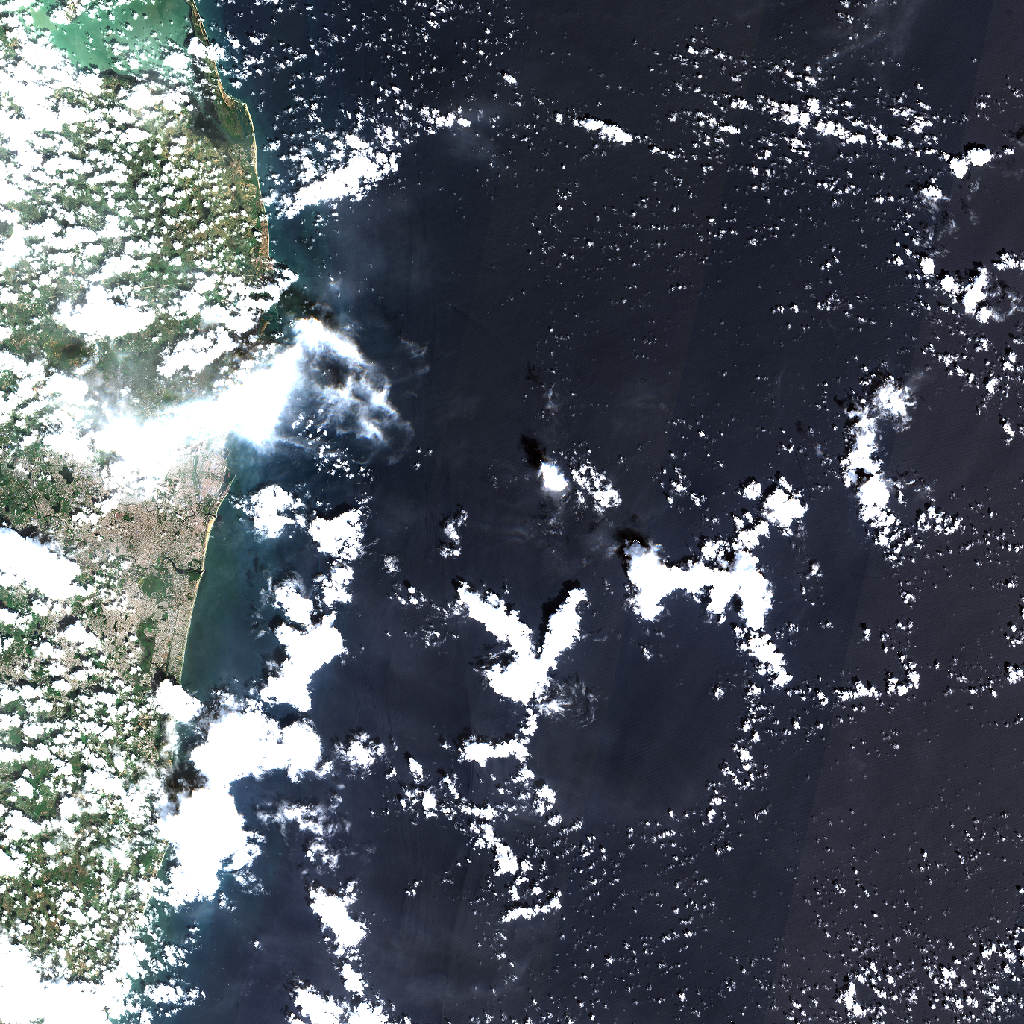
This preview, captured by the Sentinel-2 satellite from its orbit at approximately 786 km above Earth, shows the Chennai-region Imagery observed on 2025-10-16.
This month's environmental digest for the Chennai region reveals a nuanced landscape where vegetation and built-up areas coexist. Using Sentinel-2 satellite data from October 16, 2025, with a cloud cover of 39.39%, we analyze the Normalized Difference Vegetation Index (NDVI) and Normalized Difference Built-up Index (NDBI) to assess vegetation health and built-up intensity. This monthly digest, sourced from the Microsoft Planetary Computer, highlights the contrasting patterns of green and urban spaces in the region.
Info Box for Awareness
Why this matters
At I Hug Trees we turn science into awareness so that we understand how humanity's effort and nature's wonders shape the living balance of our green spaces. The green patches around the globe vanish and recover telling us a story of resilience and renewal. Is it not? As we aim to bring scientific credibility into our numbers and maps we help everyone see what connects us all.
Understanding NDVI and NDBI
Satellites like Sentinel-2 capture sunlight reflected from the Earth in many narrow colour ranges, called spectral bands. Plants and trees reflect more light in the near-infrared band and absorb more in the red band, that’s how NDVI helps us see how green or healthy an area is. NDBI uses other bands to highlight built-up areas, showing how vegetation and development change side by side. Together, they help us understand the story of our landscapes, where green spaces thrive and where it needs care.
Methodology
NDVI (Normalized Difference Vegetation Index) values were derived from Sentinel-2 imagery using red (B04) and near-infrared (B08) bands. Cloud masks were applied using QA60 flags. Images were processed at 10 m resolution through the Microsoft Planetary Computer API. Monthly NDVI averages are compared over time to assess vegetation trends and greenness changes. Note: Some summary insights in this analysis were generated with the help of AI tools. All satellite data and numerical outputs are based on verified Sentinel-2 observations.
Data integrity & processing note
All datasets are processed using open satellite imagery from the Microsoft Planetary Computer and verified with consistent parameters such as cloud cover, resolution, and band alignment. Each NDVI and NDBI image is generated using reproducible Python workflows to maintain scientific credibility.Data processing and map generation were performed using AWS cloud infrastructure.
NDVI & NDBI Historical Trends - Chennai-region
This graph shows monthly NDVI and NDBI values, capturing how vegetation and built-up areas changed across the Chennai-region throughout the year.
NDVI
NDVI — color visualization
NDVI — greyscale (index values)
NDVI csv values
No CSV data available.
NDBI (Built-up Index)
NDBI — color visualization
NDBI — greyscale (index values)
NDBI csv values
No CSV data available.
NDVI − NDBI & Heat Risk
Difference visualization — highlights vegetation vs built-up dominance.
Heat risk interpretation derived from NDVI–NDBI difference.
The NDVI values for the Chennai region range from a minimum of 0.023 to a maximum of 0.812, with a mean of 0.315 and a median of 0.301. This indicates a moderate level of vegetation cover across the region, with some areas showing dense vegetation. The NDBI values range from -0.432 to 0.654, with a mean of 0.201 and a median of 0.195, suggesting a significant presence of built-up surfaces. The mean difference between NDBI and NDVI is 0.014, indicating that built-up surfaces slightly predominate over vegetation. The NDVI–NDBI difference map (see ndvi_ndbi_diff_color.png) shows areas where built-up surfaces exceed vegetation, flagging these zones as higher heat-risk on the heat-risk map (see heat-risk.png).
- Areas with NDVI values above 0.5 likely represent dense vegetation and potential cooling zones.
- Regions with NDBI values above 0.4 indicate significant built-up areas, which may experience higher urban heat.
- The difference map highlights transitional zones where vegetation and built-up areas intermingle.
3D Renders (Rayshader & Rayrender)
Rayshader 3D visualization derived from NDVI height-extrusion
Rayrender 3D visualization derived from NDVI height-extrusion
Interactive NDVI overlay (zoom, pan, transparency). Use it alongside the static maps above.
To explore the detailed NDVI and NDBI maps, visit the interactive overlay at ndvi_map.html. Use the zoom function to examine specific areas, adjust the transparency slider to compare layers, and validate features against high-resolution basemaps. Note that cloud cover may affect certain regions, as indicated in the metadata. We recommend field validation and a consistent monitoring cadence to ensure accurate assessments.
Urban heat island effect
Our analysis indicates that built-up surfaces slightly predominate in the Chennai region, with a mean difference of 0.014 (NDBI - NDVI). This suggests increased urban heat risk in areas where NDBI exceeds NDVI. To address this, we recommend a monthly monitoring cadence, prioritizing green infrastructure projects in high NDBI zones, and engaging the community in urban cooling initiatives. Disclaimer: this analysis refers to the satellite crop / geo-bounds stored under the 'Chennai-region' folder (may include extended suburbs) and does not represent the full administrative limits of Chennai.
Get involved
Every dataset, image, and map here is part of a bigger mission — to connect people with the science behind urban greenery. If this work inspires you, there are more ways to explore and participate:
- Read our Urban Forestry Daily Digest — a quick way to stay updated on global green space insights and local restoration efforts.
- Explore the latest Melbourne NDVI Digest to see how vegetation trends compare across regions.
- Visit our feature article Urban Forestry and Green Living to understand how urban forests improve our health, climate, and community life.
Join us in sharing awareness, supporting greener city planning, and bringing data-driven stories of hope to light. Email: nature@ihugtrees.org Have a place in mind you’d like us to study next? Share the city or region name where you’d love to see an NDVI and NDBI analysis.
Alternatively, send us an email directly. We review every suggestion to understand where green monitoring can create the most impact.References & Data
Free to Download (Please cite):
I Hug Trees NDVI Data Citation:
The NDVI and NDBI GeoTIFF and images are provided by I Hug Trees for scientific purposes. Please cite as:
    @misc{ihugtrees_ndvi_2025,
      author    = {I Hug Trees},
      title     = {NDVI and NDBI Analysis Data - Chennai region 2025},
      year      = 2025,
      note      = {GeoTIFF and images provided for scientific purposes},
      url       = {https://ihugtrees.org}
    }
Microsoft Planetary Computer Citation
If the Planetary Computer is useful for your work, please cite it using this record on Zenodo:
    @software{microsoft_open_source_2022_7261897,
      author       = {Microsoft Open Source and
                      Matt McFarland and
                      Rob Emanuele and
                      Dan Morris and
                      Tom Augspurger},
      title        = {microsoft/PlanetaryComputer: October 2022},
      month        = oct,
      year         = 2022,
      publisher    = {Zenodo},
      version      = {2022.10.28},
      doi          = {10.5281/zenodo.7261897},
      url          = {https://doi.org/10.5281/zenodo.7261897}
    }